
The house is quiet for another twenty minutes, and you're going through the list — trip form, swim kit, the plumber, the deck Priya has chased twice, that thing in the class group from Sunday.
None of it is hard. It's just all yours to remember, and the remembering is the part that costs something. Nobody counts the holding.
So the Daily Brief holds it instead. Not "you have 7 unread" — one message that has already been through everything and knows what today needs.
One message, already worked out
It's already there when you pick up your phone — on WhatsApp if that's where you live, otherwise in the app. It was put together while you were asleep, so there's no spinner and nothing to ask for.
The timing matters as much as the content. Every morning has a window where you're still deciding the day rather than living it, and it sits in a different place for everyone — before the school run for one person, on the train for the next. Land inside it and the brief is worth opening. Land after it and the same words are an interruption.
It works because it reads your whole world at once — email, calendar and WhatsApp together. The rain doesn't know about the school run. Your calendar doesn't know a form came in as an attachment. The class group doesn't know Saturday is free. On its own each of those is an alert you already get and already swipe away. Joined up, they turn into something you can act on.
It also doesn't split work from home. The 09:30 client review and the trip form are the same morning; they only feel like two separate problems because they live in two separate apps, and you're the one holding both.
Act: three things, each one a tap
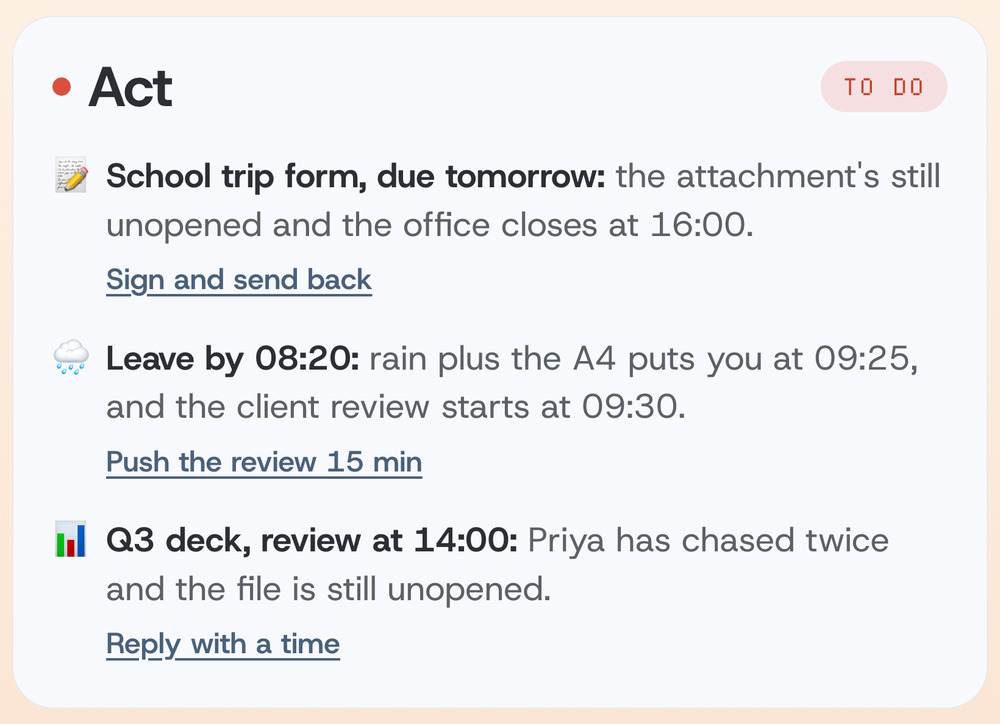
"School trip form, due tomorrow — sign it and I'll send it back."
Not "you have a form to deal with." A decision you can finish in the time it takes to find your keys.
That's what the button under each line is for — Sign and send back, Push the review 15 min, Reply with a time. Tapping it opens the chat with the whole context already there, and Toqi does the thing: drafts the reply, moves the meeting, sends the RSVP. You say go, and it's gone. Nothing leaves without you, and it stops at the checkout page — paying is the one thing it won't do on your behalf.
That's the difference between a brief and a summary. A summary tells you what's waiting. This one closes it.
Three is a hard cap. Four is a list, and a list gets scrolled past — you have enough of those. And every line tells you why: "rain plus the A4 puts you at 09:25, and the client review starts at 09:30." You shouldn't have to open three apps to check whether we're right.
Watch: things you can stop rehearsing
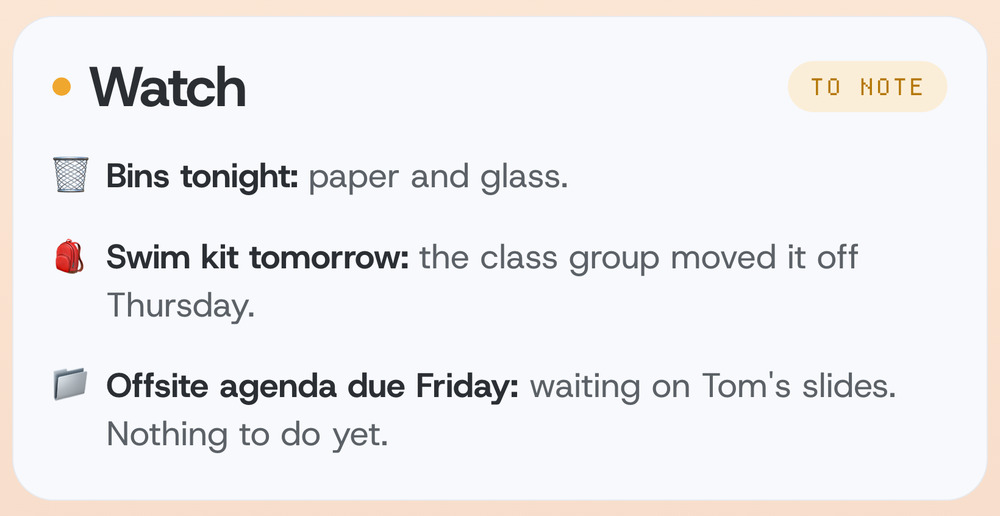
Bins tonight. Swim kit tomorrow. The offsite agenda's due Friday and Tom's slides haven't landed.
Nothing here needs you this morning. It's here so you can stop running the list in the shower — it's being watched, and it moves up to Act on the day it matters.
Settled: the one that isn't about information
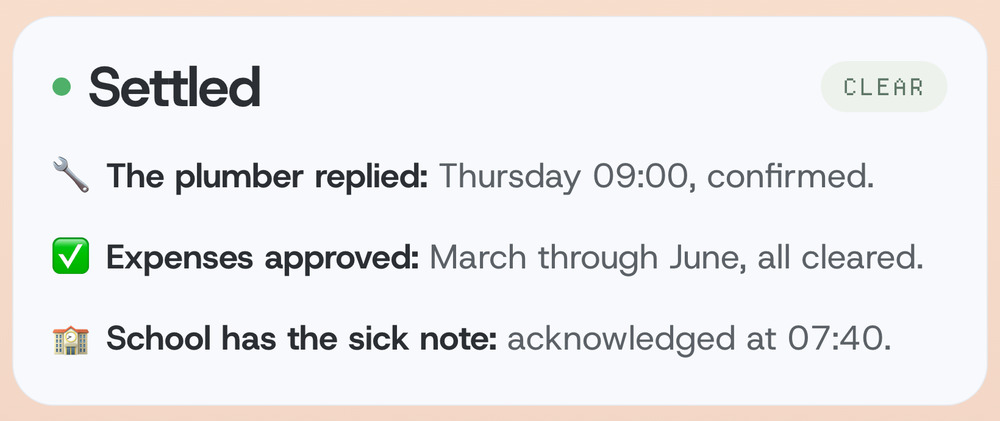
The plumber replied. Your expenses cleared. School has the sick note.
This is the lane people ask why we keep, because there's nothing to do in it. It's doing a different job: it's the proof you can put something down. Most of the weight of a week is carrying open questions, and closing them out loud is worth more than another reminder.
What it never does
No counts — "7 unread" is a weight, not information. Never the word overdue; you know, and being told off by software before breakfast helps nobody. And it won't repeat a nudge you're already getting — those collapse into one line at the bottom: "two nudges later today: passport 10:00, dentist 17:45."
Anything to do with your kids shows its reasoning and asks first. Logistics can go ahead alone — move the delivery, chase the quote — because undo is cheap and nobody else is affected. Where a child is involved, being wrong costs someone who didn't opt in.
Some mornings it's three lines
On a quiet day you read it in fifteen seconds and close it, and the greeting says "quiet one today" rather than padding the lanes to look busy. That's the product working. A brief that manufactures urgency to justify itself is a brief you eventually mute.
The open question
We'll know by the end of September whether things in Act actually get done or just get read.
That's the uncomfortable measure, and it's the right one. Opens don't count for much here. If you read it every morning and nothing ever gets finished, then it isn't taking anything off you — it's just a nicer way of being told what you already knew before you came downstairs. If that's what the data says, the answer is fewer and better lines, not more of them.